
“Gone are the days of heavy lehengas that feel like armour.” That line, from a Masala Thai roundup of the desi wedding trends couples are choosing in 2026, is doing more than it lets on. It captures exactly where desi bridal fashion in 2026 is heading: away from weight as proof of love, and toward an outfit a bride can actually survive. For generations, the heft of a bridal ensemble was the point. More zardozi, more velvet, more kilos of embroidery meant more status, more occasion. The bride who could barely lift her arms by the walima had, in a sense, won. That equation is quietly breaking.
Look at what brides are buying this season and the whole story sits in the fabric. Organza, chiffon, georgette and soft silk have edged past the old heavyweights of brocade and velvet, chosen specifically because they breathe and move through hours of ritual. Designers have leaned in with thread-painting techniques that mimic the visual density of heavy embroidery while keeping the garment light enough to dance in — the impact of a kilo of zari at a fraction of the load.
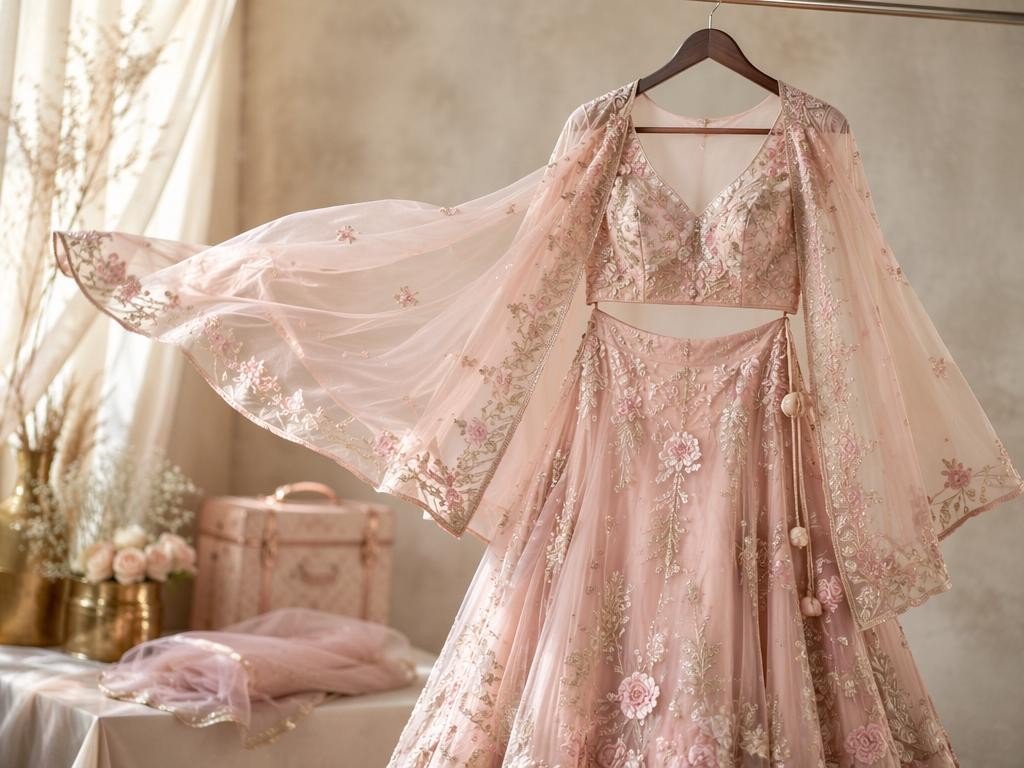
Then there’s the engineering, because that’s genuinely what it is. The defining innovation of the season isn’t a colour or a neckline, it’s the detachable piece. Cape sleeves that unhook. Dupattas that lift away. Jackets and drapes built to come off between events. A single lehenga can now carry a bride from a heavily layered ceremony look to a stripped-back reception silhouette without a full costume change. Convertible two-piece sets, separable blouses and lighter skirts that pair with multiple tops are being sold on value as much as comfort — one outfit, several lives. Even the silhouettes leaning most Western, the flowy Anarkali-style gowns and saree-gowns Masala Thai flags as rising, are prized precisely because they let a bride move through a long function the way a good dress would.
The couture houses have stopped treating comfort as the enemy of grandeur. DESIblitz, previewing the designers set to define 2026, puts the shift bluntly: bridalwear “is no longer about excess weight or rigid tradition, but intelligent design that adapts to modern lifestyles.” Tarun Tahiliani is building engineered blouses made for movement. Jayanti Reddy is pairing handwoven silks with easy jackets and corsets. Even the maximalists are sculpting their drapes to sit lighter on the shoulders. The tech-meets-tradition language isn’t marketing fluff; it describes a real change in how these garments are constructed.
For the diaspora bride, this is less a trend than a survival kit. A full Pakistani wedding can run five or six outfits across dholki, mayoun, mehndi, nikkah, baraat and walima, according to the bridalwear guide Karigur — a wardrobe, not a dress. Stage those events across continents, as so many NRI weddings now are, with a mehndi in Toronto and a reception in Dubai, and every kilo and every non-reworkable piece becomes a logistical and financial headache. Lighter, modular clothes travel. They fold into a suitcase, clear an airport, and don’t demand a separate ensemble for every single function.
Which is why the smartest strategy circulating this season is refreshingly unromantic: pick one hero outfit, almost always the baraat, and go all in there. Karigur’s advice is to keep everything else “lighter spend, reused, restyled, or rented,” so the bride ends the week neither exhausted nor overspent. It maps neatly onto how designers now pitch to NRI brides across the UK, US and the Gulf — rewearability and conscious luxury over one-and-done spectacle. The dupatta that detaches for the reception is also the dupatta you might actually wear again.
None of this means the grandeur has gone anywhere. The 2026 bride, as DESIblitz frames it, wants “comfort, camera impact and versatility without sacrificing heritage or grandeur,” and camera impact is doing real work in that sentence. Outfits are being designed to photograph across distances and angles, to hold up on a phone screen shared from London to Lahore within the hour. A garment now has to satisfy the room, the lens, and the family group chat at once, all while letting its wearer sit down for dinner.
That’s the quiet revolution under the organza. For a very long time, desi bridal fashion was engineered around everyone except the woman inside it — the guests, the photographs, the family’s standing. The detachable sleeve and the featherweight lehenga flip that. They start from an almost radical premise: that the bride should be able to breathe, move, dance and make it to the walima without being carried there by her own outfit. Tradition isn’t being thinned out. It’s being redesigned around the person it was always meant to celebrate.
Sources
- Masala Thai — Top Modern Desi Wedding Trends Couples Are Choosing in 2026
- DESIblitz — South Asian Bridalwear Designers set to Define 2026
- Karigur — Guide to South Asian Bridal Wear
SEO
- SEO title: Desi Bridal Fashion 2026: Lighter, Detachable, Comfier
- Meta description: Organza, detachable dupattas and featherweight lehengas define desi bridal fashion in 2026, as diaspora brides finally pick comfort over kilos of zari.
- Focus keyword: desi bridal fashion 2026
- Secondary keywords: detachable dupatta lehenga, breathable bridal fabrics, NRI bride outfits
- Slug: desi-bridal-fashion-2026-breathable-detachable
- Category: Culture & Diaspora
- Tags: South Asian diaspora, desi wedding fashion, bridal lehenga 2026, NRI brides, detachable dupatta, breathable fabrics