
On August 28, ten institutional investors wired ₹306 crore into a company most of their own relatives probably know as “the site where you buy your sister’s wedding lehenga.” That’s the anchor round for Purple Style Labs, the parent of Pernia’s Pop-Up Shop, which opened its ₹680 crore IPO three days later at a price band of ₹546–575 a share. Shares list on the NSE and BSE on September 7. The number that makes bankers sit up isn’t the raise itself — it’s what happened before it.
Purple Style Labs bought Pernia’s Pop-Up Shop in February 2018 for ₹12 crore. At the top of this IPO’s price band, the company is valued at ₹4,603 crore. That’s roughly 383 times what it cost eight years ago — the kind of multiple usually reserved for software, not a platform that ships bridal lehengas and sherwanis.
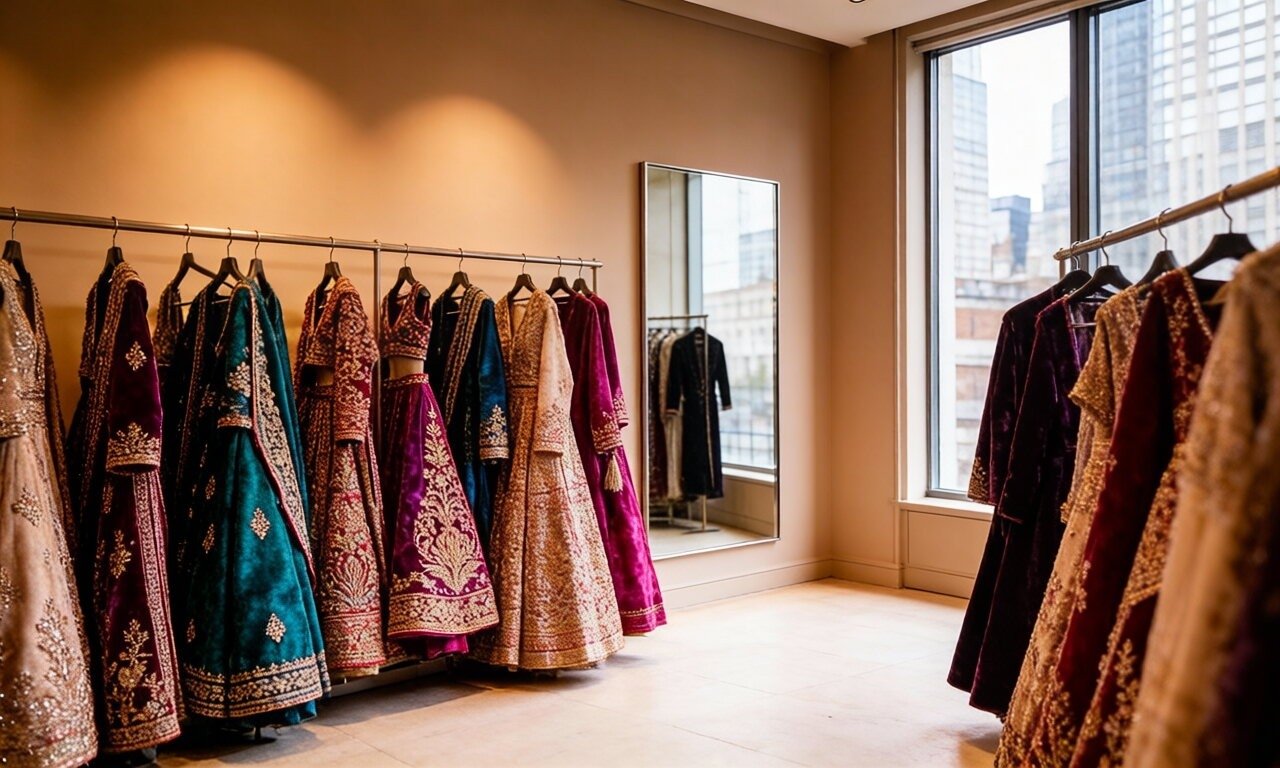
What it actually sells is worth spelling out, because “fashion e-commerce” undersells it. Pernia’s Pop-Up Shop curates a portfolio of 1,109 active designer brands — womenswear, menswear, jewellery, kidswear, heavy on wedding and occasion wear — and sells across a website, an app, phone concierge, and 14 physical Experience Centers. Twelve of those are in India. The other two are in London and New York.
Those last two locations are the tell. A diaspora bride planning a wedding in New Jersey or Wembley doesn’t want to fly to Mumbai for a fitting, but she also doesn’t want to buy her lehenga off a grainy Instagram carousel. An Experience Center in London or New York exists precisely for her — a way to touch the fabric, get measured, and walk out with a genuine Anita Dongre or Sabyasachi piece without the flight. It’s the diaspora wedding market treated as a business line worth staffing a permanent showroom for, not an afterthought served by international shipping.
The revenue growth backs up why investors care. FY20 revenue was ₹45 crore; by FY24 it had crossed ₹500 crore, a compound annual growth rate of roughly 61% across five years. Some of that tracks a broader market: India’s wedding apparel spend is projected near ₹1.41 lakh crore, and the country’s destination-wedding segment alone is forecast to grow from $2.66 billion in 2025 to $8.29 billion by 2032, a 25.5% annual clip. Myntra has reported its own premium ethnic-wear category more than doubling year-on-year, with most of that growth outside the biggest metros. Designer bridal wear, in other words, stopped being a niche luxury purchase confined to a handful of Mumbai and Delhi families and became a scaling national — and increasingly international — retail category.
The investor list tells its own story about how seriously that category is now taken. Alongside institutional backers like Volrado, Singularity, SageOne, and Bajaj Holdings sits a roster of Bollywood and cricket royalty: Shah Rukh Khan, Salman Khan, Sachin Tendulkar, Madhuri Dixit, Mahesh Babu. These aren’t brand-ambassador cameo deals — they’re cap-table positions in a business built on designer wedding wear. When cricket and film’s biggest names put their own money behind a fashion platform rather than just endorsing one, it signals something about how investable South Asian designer fashion has become as an asset class, not just a spending category people write op-eds about every wedding season.
None of this means the IPO is a sure thing — grey market premiums have hovered around a modest ₹28 a share, a far cry from the frenzy multiples that sometimes greet Indian tech listings, and a 383x paper gain on an eight-year-old acquisition is exactly the kind of number public-market skeptics will pick apart in the weeks after listing. But the underlying shift is harder to argue with. A company built on curating designer lehengas for weddings from Ludhiana to Long Island is now subject to quarterly earnings calls, institutional scrutiny, and a public share price — the same machinery that tracks a bank or a software firm.
For a diaspora family, the practical version of this story is simpler: the platform where you already source your wedding wardrobe just got a lot more capital, a lot more scrutiny, and a lot more reason to keep opening Experience Centers in the cities where its actual customers live. Whether that capital shows up as better fittings in London and New York, or just a bigger balance sheet in Mumbai, is the thing worth watching once the champagne from listing day wears off.
Sources
- Storyboard18 — Aug 28, 2026: Purple Style Labs IPO values Pernia’s Pop-Up Shop at ₹4,603 crore
- Storyboard18 — Aug 31, 2026: Purple Style Labs opens ₹680 crore IPO, prices shares at ₹546–575
- India Infoline — Purple Style Labs IPO: GMP, Price Band, Dates, Financials
- GrabOn — Indian Wedding Industry Statistics 2026: Cost & Market Size
- First Resort by Ramola Bachchan — Indian Wedding Fashion Statistics 2026