
A recipe rarely crosses a border in a neat line. It arrives folded into memory, measured by the palm of a grandmother’s hand, adjusted for whatever is available in the new kitchen, and eventually typed into a family WhatsApp message with at least one instruction missing. The dish may look familiar when it reaches the table. The story inside it has already travelled a long way.
For South Asian diaspora families, food is often the most practical form of cultural memory. It does not require a formal lesson or a perfect command of a heritage language. A child can learn a family history through the smell of fried onions, the argument over how much chilli belongs in dal, or the particular way someone folds a samosa. Food carries knowledge quietly because it is repeated: at birthdays, religious festivals, Sunday lunches, student flats and hurried weeknight dinners.
UNESCO describes foodways as living heritage because they connect communities to land, seasons, stories, migration and resilience. That word, living, matters. A family dish is not preserved by freezing it in its original form. It survives because someone finds substitute greens in a supermarket, changes the heat for a child, stretches a recipe to feed unexpected guests, or combines it with something learned in the new country.
Research on Indian migrants in the Netherlands has linked food from home, cooking practices and food sharing with belonging, care and family relationships. Food can operate as what researchers call a social remittance: an idea or practice carried across borders, not in a suitcase but through people. A recipe sent from Birmingham to Nairobi, or from Ahmedabad to New Jersey, can be a small domestic exchange that keeps a relationship active across time zones.
That exchange is rarely neutral. In a study of Gujarati transnational families in northern New Jersey, participants described negotiating food choices between “here” and “home,” with meals helping mark family identity and community belonging. The kitchen becomes a place where migration is worked out in practical terms. Which ingredients can be found? Who eats what? Does a festival meal need to follow an older rule exactly, or can the family make room for the habits of the place where it now lives?
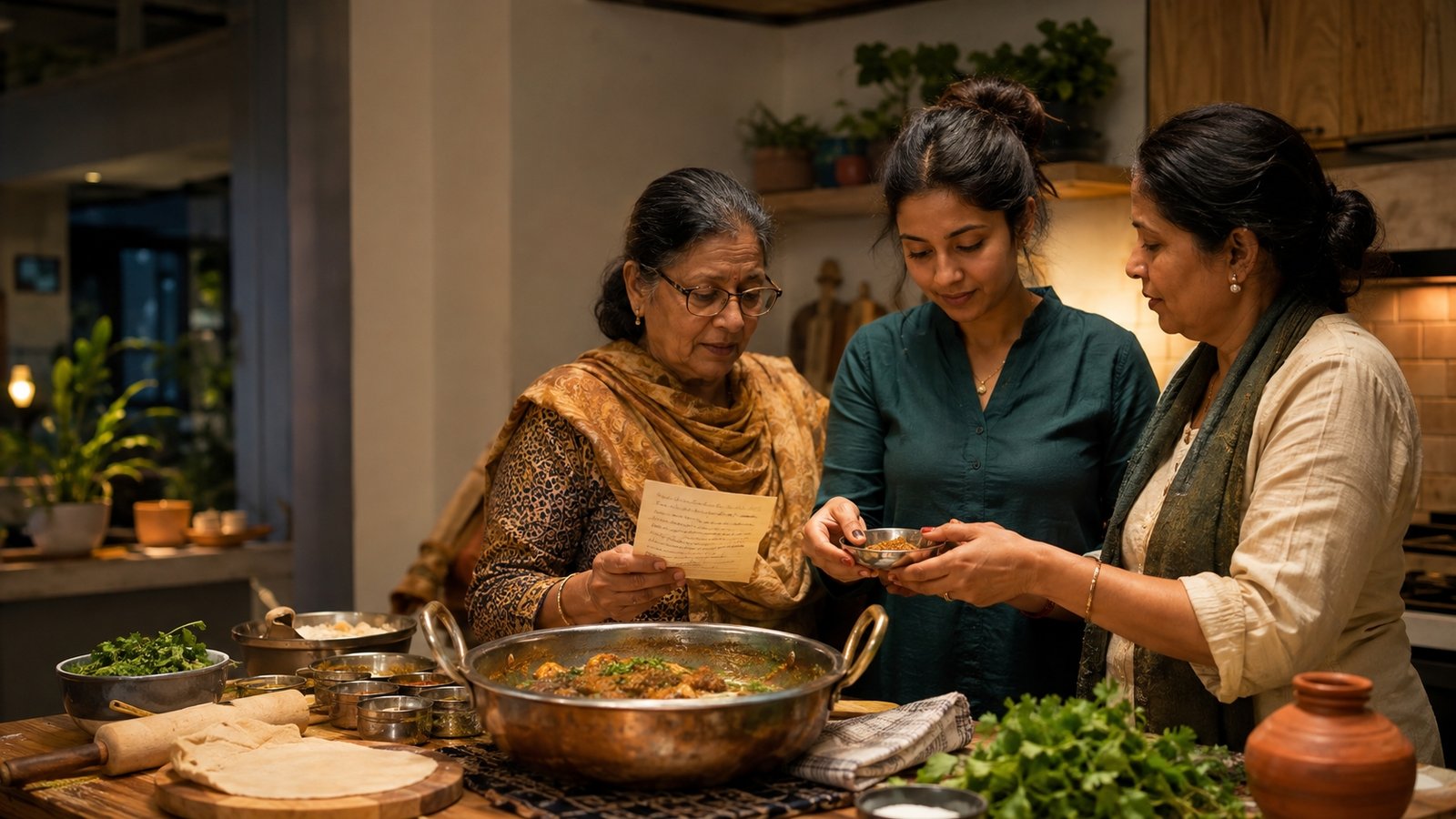
Women have often carried much of this culinary memory, even when their labour disappears into the phrase “family cooking.” Studies of South Asian diasporic cookbooks show recipes moving through oral instruction, handwritten notes, letters, diaries and informal records. These are not merely collections of ingredients. They are archives of care, adaptation and authority. A note saying “fry until it smells right” may frustrate a beginner, but it also records a form of expertise that was never designed for a measuring cup.
The result is not one diaspora cuisine. It is a map of negotiations. Indo-Caribbean roti, South African bunny chow, Malaysian nasi kandar, British restaurant curry and Americanised versions of familiar home dishes each tell different migration stories. Calling all of them simply “Indian food” misses the point. Their differences are evidence of where families settled, whom they lived beside, what ingredients they could afford, and which traditions they chose to hold close.
The second generation often inherits this map in fragments. One person knows the festival sweets but not the language of the recipe. Another can reproduce a mother’s spice blend but has changed the dish to fit a vegetarian household, a health concern or a busy work schedule. A third learns through video calls, cooking channels and shared documents rather than standing beside an older relative at the stove. The technology changes; the act of passing something on remains recognisable.
That is why arguments about authenticity can become so tiring. A family recipe is not a museum object waiting for an inspector. It is a record of movement. The version made in a London flat, a Cincinnati kitchen or a Durban family home may be just as honest as the version remembered from a village, because both contain the conditions of their time. What travels is not only flavour. It is permission to adapt without disappearing.
When diaspora families cook, they are doing more than recreating the past. They are deciding what deserves to continue, what can change and what new combination belongs to them. The recipe arrives from somewhere else, but it does not stay there. It becomes a conversation between generations, places and appetites, served warm enough for everyone to recognise a little of home.
Sources
- UNESCO — International Food Atlas
- Journal of Global Postcolonial Studies — Recipe for Identity
- Journal of Ethnic Foods / PubMed — Gujarati diaspora food practices in New Jersey
- Utrecht University — The migrant suitcase: Food, belonging and commensality among Indian migrants in the Netherlands
- Humanities — Currying Identities: South Asian diasporic women’s cookbooks