
The Indian Ocean is more than a strategic map. It is a living economic highway carrying energy, food, trade and livelihoods between Asia, Africa and the wider world. For India and Sri Lanka—neighbours separated by a narrow stretch of sea—its security is inseparable from their national wellbeing.
Recent developments suggest that New Delhi and Colombo increasingly recognise this reality. Their growing partnership now extends beyond diplomacy and development into maritime surveillance, naval training, disaster response, anti-trafficking operations and the protection of vital sea lanes.
This closer relationship matters not only to the two countries. It could also become an important model for practical South Asian cooperation.
From Neighbours to Maritime Partners
India and Sri Lanka have always been connected by geography, commerce, religion, migration and culture. However, the relationship has also experienced difficult periods shaped by domestic politics, security anxieties, fishing disputes and concerns about sovereignty.
The emerging partnership does not erase those tensions. Instead, it reflects a more practical understanding: neither country can adequately address the Indian Ocean’s challenges alone.
During Prime Minister Narendra Modi’s visit to Sri Lanka in April 2025, the two governments signed a memorandum of understanding on defence cooperation. The wider discussions covered maritime security, energy, economic recovery, digital connectivity and regional stability. Sri Lankan President Anura Kumara Dissanayake emphasised that the country would not allow its territory to be used in a manner harmful to India’s security or regional stability. Prime Minister of India
The relationship has continued to develop through high-level visits, military exchanges and operational cooperation. In August 2026, the Commander of the Sri Lanka Navy made India his first overseas destination after taking office. Discussions included joint operations, professional training, capacity building and closer coordination between the two navies. Sri Lankan Ministry of Foreign Affairs
SLINEX-26: Cooperation at Sea
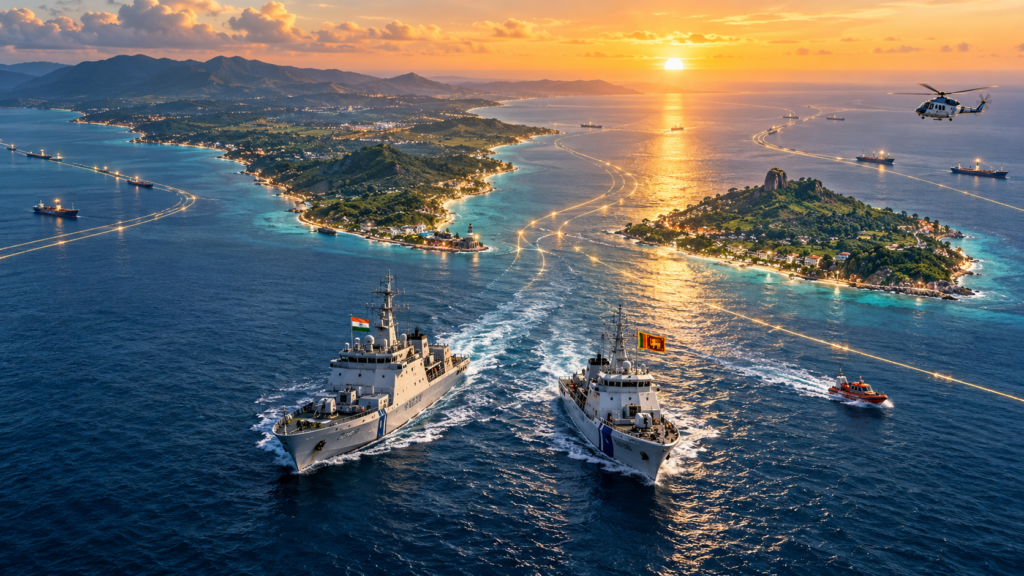
One of the clearest recent demonstrations of this partnership was the thirteenth India–Sri Lanka bilateral naval exercise, SLINEX-26, conducted in Visakhapatnam in September 2026.
Sri Lanka deployed the offshore patrol vessel SLNS Sindurala, while India was represented by the anti-submarine warfare corvette INS Kavaratti and fleet tanker INS Jyoti. The exercise included tactical manoeuvres, anti-piracy operations, surface firing and cross-deck helicopter activity.
These exercises are not merely ceremonial displays. They allow personnel to learn one another’s procedures, communicate effectively and respond together during real emergencies. SLINEX has been conducted regularly since 2005 and has gradually evolved into a platform for operational coordination and professional trust. Sri Lanka Navy
That trust is crucial in a region where emergencies can cross national boundaries within hours.
Security Is More Than Warships
The most valuable feature of India–Sri Lanka cooperation is its increasingly broad definition of security.
The threats facing the Indian Ocean include narcotics trafficking, human smuggling, illegal fishing, piracy, maritime accidents, cyberattacks, environmental disasters and extreme weather. Commercial shipping and undersea infrastructure must also be protected.
India has supported the development of Sri Lanka’s maritime awareness through a Dornier surveillance aircraft and the establishment of a Maritime Rescue Coordination Centre. The two countries have also cooperated against narcotics trafficking and discussed greater intelligence sharing, hydrographic cooperation and joint surveillance.
These arrangements can help both countries identify suspicious vessels, coordinate search-and-rescue missions and respond more quickly to accidents at sea.
Disaster relief is particularly important. India has repeatedly acted as an early responder during emergencies affecting Sri Lanka, while the two countries continue to explore joint training in disaster mitigation, rescue and rehabilitation.
In this sense, maritime security is ultimately human security. It protects fishermen, coastal communities, merchant sailors, tourists and families whose incomes depend upon the sea.
The Colombo Security Conclave
India and Sri Lanka also cooperate through the Colombo Security Conclave, a regional framework addressing maritime safety, terrorism, organised crime, cybersecurity, critical infrastructure and humanitarian assistance.
In September 2026, Sri Lankan armed-forces officers took part in specialised counterterrorism and hostage-rescue training in India under the Conclave’s framework. Such programmes create professional relationships across borders while improving the ability of regional institutions to manage shared threats. Sri Lankan Ministry of Foreign Affairs
The Conclave demonstrates that South Asian security cooperation does not always require a large, heavily centralised alliance. It can grow through focused projects, regular training, information sharing and confidence-building.
This flexible approach may be better suited to a region where countries value strategic autonomy and remain cautious about binding commitments.
Cooperation Must Reach Coastal Communities
The partnership will be judged not only in capitals or naval headquarters but also in fishing villages on both sides of the Palk Strait.
The fishermen’s dispute remains one of the most sensitive issues between India and Sri Lanka. Arrests, damaged equipment, ecological concerns and accusations of destructive fishing practices have created anger among vulnerable communities.
A genuinely cooperative security policy must treat fishermen as stakeholders rather than as obstacles. Long-term progress will require sustained dialogue, more sustainable fishing practices, alternative livelihood support and humane enforcement.
This is where South Asian cooperation must distinguish itself: security cannot simply protect borders while ignoring the people living beside them.
A Partnership Based on Confidence, Not Dependence
Sri Lanka’s location gives it enormous strategic importance, but it should not be viewed merely as an arena for competition among larger powers. Sri Lanka has its own interests, diplomatic relationships and desire for strategic independence.
India, meanwhile, benefits when its closest maritime neighbour is stable, prosperous and confident rather than economically vulnerable.
A durable partnership must therefore be based on consultation, transparency and mutual respect. India’s greater size and resources create an unavoidable asymmetry, but asymmetry does not have to mean domination. It can support cooperation when the larger partner listens carefully and the smaller partner’s sovereignty remains central.
For Sri Lanka, cooperation can strengthen surveillance, training, disaster preparedness and maritime infrastructure. For India, it improves awareness and coordination near strategically important sea lanes. For both, it reduces the space available to traffickers, criminals and other destabilising actors.
A South Asian Vision for the Indian Ocean
India and Sri Lanka’s closer relationship offers a wider lesson for South Asia.
The region is often described through its rivalries, political divisions and missed opportunities. Yet shared seas, rivers, climate risks, trade routes and cultural connections make cooperation unavoidable.
A more confident South Asian approach would focus on areas where interests naturally overlap:
- Coordinated disaster and cyclone response
- Search-and-rescue operations
- Action against trafficking and organised crime
- Sustainable fisheries and marine conservation
- Protection of ports, shipping and undersea infrastructure
- Maritime training and information sharing
- Cleaner energy and regional connectivity
- Scientific research into oceans and climate change
These are practical goals capable of producing visible benefits without requiring every political disagreement to be settled first.
Conclusion: Security Through Solidarity
India and Sri Lanka are moving closer because geography, economics and shared vulnerabilities make cooperation increasingly necessary. Naval exercises and defence agreements attract attention, but the deeper story concerns institutional trust: learning to communicate, prepare and act together.
The relationship will still face disagreements, particularly over fishing rights, domestic sensitivities and regional geopolitics. Its success will depend on whether both governments can manage those differences openly and fairly.
If they can, India and Sri Lanka may demonstrate that Indian Ocean security need not be defined solely by military competition. It can also be built through rescue operations, environmental protection, sustainable livelihoods, shared intelligence and respect between neighbours.
That would represent more than a bilateral achievement. It would offer a hopeful model of South Asian cooperation—one in which regional stability grows not from isolation, but from solidarity.