
By AIE Editors
For most of the modern era, the US dollar has been the central language of international finance. It prices commodities, settles trade, anchors foreign-exchange reserves and connects banks across borders. For South Asian economies, access to dollars remains essential for importing energy, servicing debt, purchasing technology and stabilising national currencies.
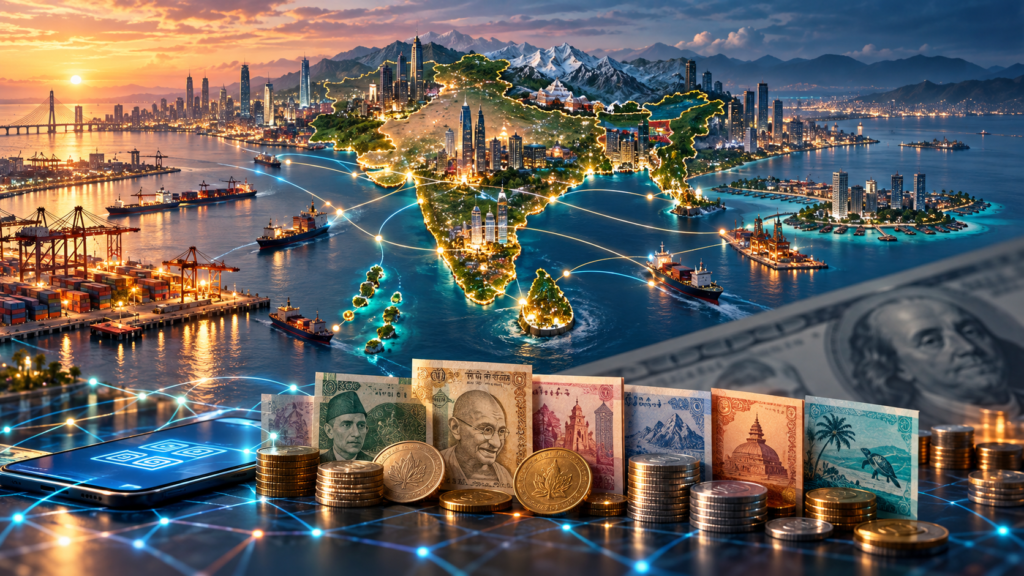
But the dollar is no longer viewed as a completely neutral instrument. The freezing of sovereign reserves, restrictions on banking access and expanding use of financial sanctions have demonstrated how control over currencies and payment networks can become an instrument of geopolitical power. Critics describe this as the “weaponisation of the dollar”: the use of America’s central position in global finance to influence the behaviour of states, companies and financial institutions.
This does not mean South Asian countries are preparing to reject the dollar. The region is pursuing something more practical: creating alternatives so that a disruption in one financial channel does not paralyse an entire economy.
Why South Asia is particularly vulnerable
South Asian nations share several financial pressures. Many import large quantities of fuel, machinery, medicine and industrial materials. Several carry substantial foreign-currency debt, while their earnings from exports, tourism and remittances can fluctuate sharply.
When the dollar strengthens, the cost of imports and debt repayments rises in local-currency terms. Businesses must find more domestic currency to pay the same dollar invoice. Governments can then face pressure on their reserves, exchange rates and inflation.
Sri Lanka’s economic crisis demonstrated how quickly shortages of foreign currency can affect fuel supplies, transport, power generation and daily life. Pakistan, Bangladesh and the Maldives have also experienced periods of pressure on dollar liquidity. Even stronger economies remain exposed to changes in US interest rates and global capital flows.
The lesson is not that the dollar caused every crisis. Domestic debt, fiscal policy, import dependence and political decisions all matter. The deeper lesson is that depending overwhelmingly on one currency creates a strategic vulnerability.
India’s cautious rupee strategy
India is leading the region’s attempt to broaden the available options. The Reserve Bank of India permits international trade to be invoiced and settled in Indian rupees through Special Rupee Vostro Accounts. Its guidance describes rupee settlement as an additional arrangement that complements—not replaces—the existing system based on freely convertible currencies.
This distinction is important. India is not demanding the immediate displacement of the dollar. It is gradually constructing an alternative network through which willing trading partners can settle eligible transactions without converting every payment into dollars first.
India has also concluded local-currency settlement arrangements with countries including the United Arab Emirates, Indonesia, the Maldives and Mauritius. These mechanisms can reduce conversion costs, shorten settlement chains and make bilateral trade less vulnerable to interruptions in dollar liquidity.
For the rupee to become much more influential internationally, however, overseas businesses must be able to use or invest the rupees they earn. Currency internationalisation therefore depends on deep financial markets, predictable regulation, confidence in monetary stability and attractive rupee-denominated assets.
Sri Lanka: diversification after crisis
Sri Lanka’s experience makes the case for greater financial flexibility especially powerful. The Central Bank of Sri Lanka authorised the Indian rupee as a designated foreign currency in 2022. This did not make the rupee legal tender for ordinary domestic transactions. Instead, it created another channel for trade and investment involving India.
In February 2025, Indian and Sri Lankan officials, banks and business representatives held discussions in Colombo on expanding INR–LKR trade settlement. The initiative aims to reduce the expense of converting transactions through a third currency and strengthen formal banking channels between the two countries.
Sri Lanka will continue to require dollars for global imports and external debt. Nevertheless, settling a greater portion of regional trade in local currencies could preserve scarce dollars for transactions where no practical alternative exists.
Bangladesh and regional clearing
Bangladesh participates in the Asian Clearing Union, which allows member states to settle eligible regional transactions multilaterally. Rather than every payment being settled separately, obligations can be offset against one another before the remaining balance is paid.
This principle could become increasingly valuable. If regional countries import from and export to one another, net settlement can reduce the amount of hard currency required to support the same volume of trade.
Local-currency arrangements will only succeed when businesses find exchange rates transparent, currencies usable and the settlement process simpler than established alternatives.
Pakistan and the growing role of the renminbi
Pakistan’s financial diversification has developed partly through its close economic relationship with China. The State Bank of Pakistan has established a regulatory framework supporting trade and investment transactions in Chinese renminbi. According to the central bank, the share of Pakistani imports from China denominated in renminbi rose from roughly 2% in the 2017–18 financial year to around 18% in 2021–22.
Renminbi settlement can reduce the need to obtain dollars for transactions involving Chinese suppliers. Pakistan has also upgraded its domestic settlement infrastructure through PRISM+, a real-time system based on the ISO 20022 financial messaging standard.
Yet replacing dependence on one major external currency with dependence on another would not create genuine resilience. Pakistan’s longer-term protection will come from stronger exports, sounder public finances, adequate reserves and access to several payment channels rather than a single substitute currency.
Nepal, Bhutan and the digital-payment bridge
Nepal and Bhutan illustrate another part of this transformation: the connection between regional finance and digital-payment technology. India’s Unified Payments Interface has expanded across nearby economies. Indian visitors can make QR-based payments at participating merchants in Nepal, while UPI and RuPay services have also reached Bhutan. Nepal’s central bank has reported work on broader cross-border payment integration.
These systems are designed primarily for consumers, tourism and remittances, but their strategic significance is larger. They show that regional payments can move through interoperable digital infrastructure without relying exclusively on traditional international card and banking networks.
Digital systems bring their own risks, including cyberattacks, surveillance, technical concentration and capital-flight concerns. Their resilience will depend on strong regulation, privacy protections and genuine interoperability rather than control by one dominant platform.
The Maldives: liquidity as national security
The Maldives is especially sensitive to foreign-currency conditions because tourism generates much of its income while essential goods are heavily imported.
In 2024, the Maldives Monetary Authority signed a currency-swap agreement with the Reserve Bank of India. The arrangement included access to both a dollar/euro window and an Indian-rupee window. Currency swaps provide temporary liquidity during periods of external pressure and can help stabilise reserves.
Such agreements do not remove underlying economic vulnerabilities. They do, however, give smaller economies a larger financial safety net—and more than one door through which emergency liquidity can arrive.
What real financial resilience would require
South Asia’s preparations extend beyond replacing dollars with rupees, renminbi or another currency. A durable strategy would contain several connected elements:
- More trade in regional currencies where commercial demand genuinely exists.
- Interoperable payment systems capable of operating across borders quickly and securely.
- Currency-swap arrangements providing emergency liquidity during periods of market stress.
- Diversified reserves held across currencies, gold and other liquid assets.
- Deeper domestic financial markets offering credible places to save and invest.
- Stronger exports and regional supply chains that reduce chronic foreign-currency shortages.
- Responsible borrowing, particularly where revenue is earned locally but debt must be repaid in dollars.
- Regional cooperation that remains commercially useful even when political relationships become difficult.
None of these measures offers instant protection. Local currencies can be volatile, regional trade remains limited and South Asian political tensions often obstruct economic integration. Trust cannot be created through technical agreements alone.
Diversification, not de-dollarisation
The dollar retains enormous advantages: liquidity, global acceptance, deep capital markets and an established financial infrastructure. IMF reserve data continues to show its central role in the international monetary system, even as reserve managers gradually diversify.
Predictions of the dollar’s immediate collapse are therefore unconvincing. So are claims that every local-currency agreement represents a coordinated revolt against the United States.
What is happening is quieter and potentially more significant. South Asian countries are learning that monetary resilience comes from optionality. A nation with several settlement systems, multiple reserve assets and stronger regional trade is less exposed to sanctions, dollar shortages, banking disruption or decisions taken thousands of miles away.
The region’s future may not be “post-dollar.” It is more likely to be multi-currency, digitally connected and strategically diversified.
That transformation will not remove geopolitics from money. But it could give South Asia greater room to protect its economies, negotiate independently and decide its future on its own terms.
Sources and further reading
- Reserve Bank of India: International Trade Settlement in Indian Rupees
- Reserve Bank of India Annual Report: Local-currency settlement arrangements
- India–Sri Lanka INR/LKR Trade Settlement Roundtable
- Central Bank of Sri Lanka: Indian Rupee as a designated foreign currency
- Bangladesh Bank: Asian Clearing Union settlements
- State Bank of Pakistan: Renminbi use in trade with China
- Nepal Rastra Bank: Cross-border payment developments
- Maldives Monetary Authority Annual Report
- IMF Currency Composition of Official Foreign-Exchange Reserves
This article is an analysis of economic and geopolitical developments and does not constitute financial or investment advice.