For decades, biologists knew the switch existed without being able to describe it. Somewhere in the stretch of DNA just before a gene, there’s a short sequence called the initiator, the exact spot where the cell’s machinery decides to start reading a gene and converting it into something functional. Everyone agreed it mattered. Almost nobody could pin down what it actually looked like, because its pattern is subtle enough to hide from the naked eye and from most conventional lab techniques. A team at UC San Diego just changed that, by building an AI model, feeding it half a million DNA variants, and letting it find the signature that generations of molecular biologists couldn’t isolate by hand.
The project, led by graduate student Torrey Rhyne-Carrigg in Professor James T. Kadonaga’s lab at UC San Diego’s Department of Molecular Biology, took a brute-force approach first. Using high-throughput DNA sequencing, the team measured gene expression activity across roughly 500,000 different versions of the initiator sequence, essentially running half a million small experiments to see which variations actually switched genes on and which didn’t. That’s not a dataset a human researcher scans by eye. It’s a dataset built specifically to be handed to a machine.
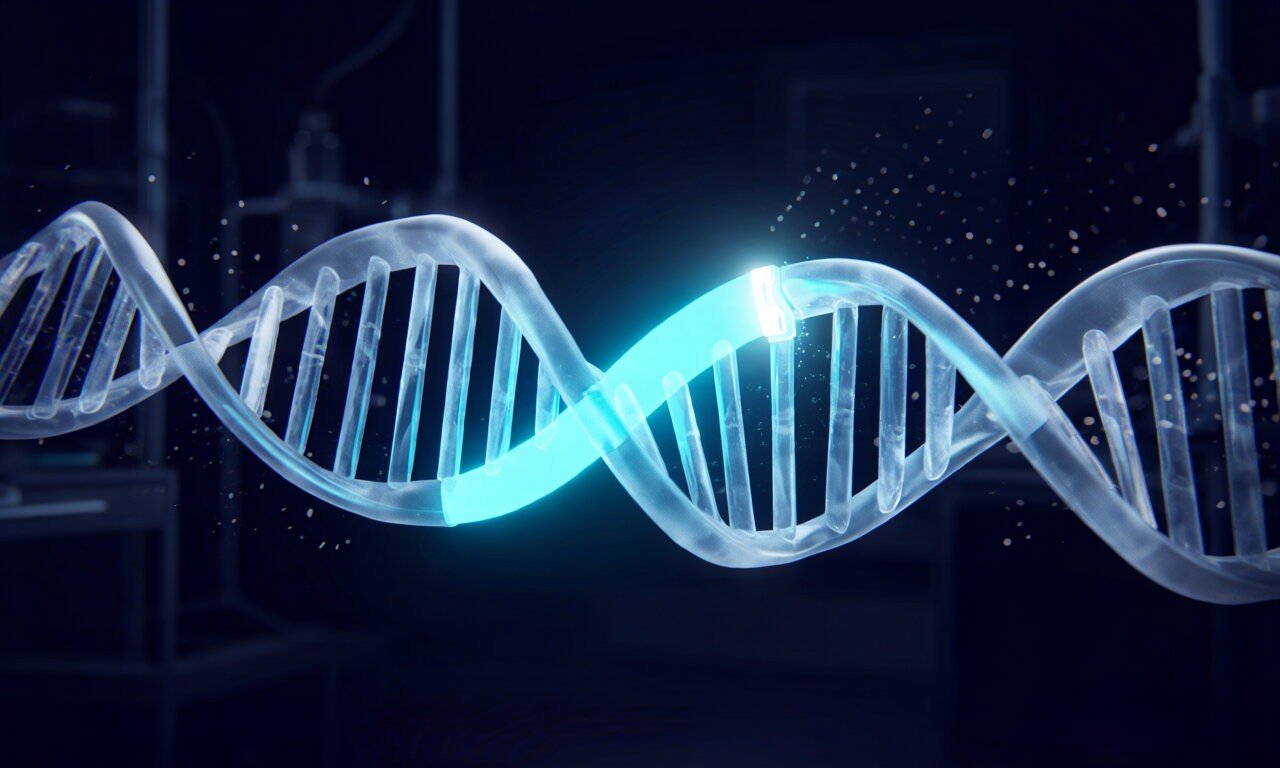
What the machine found, once trained on all 500,000 results, was a DNA pattern present in an estimated 60% of human genes, a rate that turns the initiator from a biological curiosity into something closer to a universal on-ramp for gene activation. Kadonaga put the significance plainly in describing the result: “These AI models were found to provide, for the first time, strong predictions of the presence or absence of the initiator in human genes.” That’s the part worth sitting with. Researchers had circled this element for years. What was missing wasn’t interest, it was resolution, and resolution is exactly what a model trained on 500,000 labeled examples is built to deliver.
The practical payoff runs in a specific direction: mutations. Genetic diseases, cancer prominent among them, often trace back not to the gene itself being broken but to the switch that turns it on or off malfunctioning quietly upstream. If you don’t know what a working initiator sequence looks like, you can’t reliably tell a healthy variant from a harmful one, especially in the noisy, repetitive stretches of DNA outside a gene’s coding region where mutations are hardest to interpret. Now that the pattern is decoded, researchers have a reference to scan against, a way to flag when a mutation in that region is likely to be doing real damage. The same knowledge cuts the other way too: with a known, reliable signature for “genes on,” scientists can start designing synthetic promoters engineered to switch specific functions on with a level of control that guesswork never allowed.
None of this closes the book on gene regulation, and Kadonaga was careful not to oversell it that way, framing the paper as “a step forward in the combined use of laboratory experiments and AI to decipher the information embedded in the sequence of DNA bases in humans,” not a finished map. The human genome runs to roughly 6 billion base pairs, and the initiator is one switch among a regulatory system that includes promoters, enhancers, and silencers layered on top of each other in ways still only partly understood. What changed this month, published July 31 in Genes & Development, is that one of those switches has gone from theorized to characterized, with a model that can now recognize it on sight.
That’s the quieter story underneath the headline number. Biology has spent seventy years since Watson and Crick’s structure paper reading DNA letter by letter, gene by gene, mutation by mutation. What AI adds isn’t a shortcut around that patience so much as a way to survive the sheer scale of it, to hold 500,000 data points in working memory at once and find the pattern a human eye would need a lifetime to notice. The initiator switch just became legible. Whatever regulatory element gets decoded next will likely get there the same way: not one careful experiment at a time, but half a million of them, run at once, and handed to something built to actually see the shape in all that noise.
Sources
- ScienceDaily — A hidden “on switch” in human DNA has finally been decoded, August 23 2026
- UC San Diego Today — Researchers Use AI to Decode Key DNA Sequence in Gene Activation, 2026
- Phys.org — AI decodes DNA initiator sequence found in about 60% of human genes, August 2026
- Rhyne-Carrigg, Vo Ngoc, Medrano, Gillespie & Kadonaga, “Machine learning analysis of the human initiator region reveals key features of different types of core promoters,” Genes & Development, July 31 2026