
In August 2025, Mohali police pulled a man off a flight at Delhi airport just as he was about to board for Italy, where he’d been living for over a decade. His name was Harjinder Singh, alias Ravinder Singh, and for weeks he’d been messaging Mankirt Aulakh’s management team on WhatsApp: voice notes in Punjabi, photos of Aulakh’s house, photos of his cars, threats against his family unless money changed hands. Under questioning, he admitted the whole thing was a straightforward extortion attempt: send enough fear, collect an easy payday. It barely made a ripple outside Punjabi-language press, because for Aulakh, this wasn’t new. It was the second act of something that started years earlier.
That first act traces back to 2022, when Aulakh turned up on a hit list attributed to Goldy Brar, the Canada-based gangster who publicly claimed responsibility for the murder of Sidhu Moose Wala. The Bambiha gang came after him too that year, and threats have resurfaced since, most recently an audio clip circulating online in which a caller identifying himself as gangster Lucky Patial claims credit for a fresh death threat. Aulakh has spent close to four years cycling between security upgrades and public statements downplaying the danger, which is its own kind of tell.
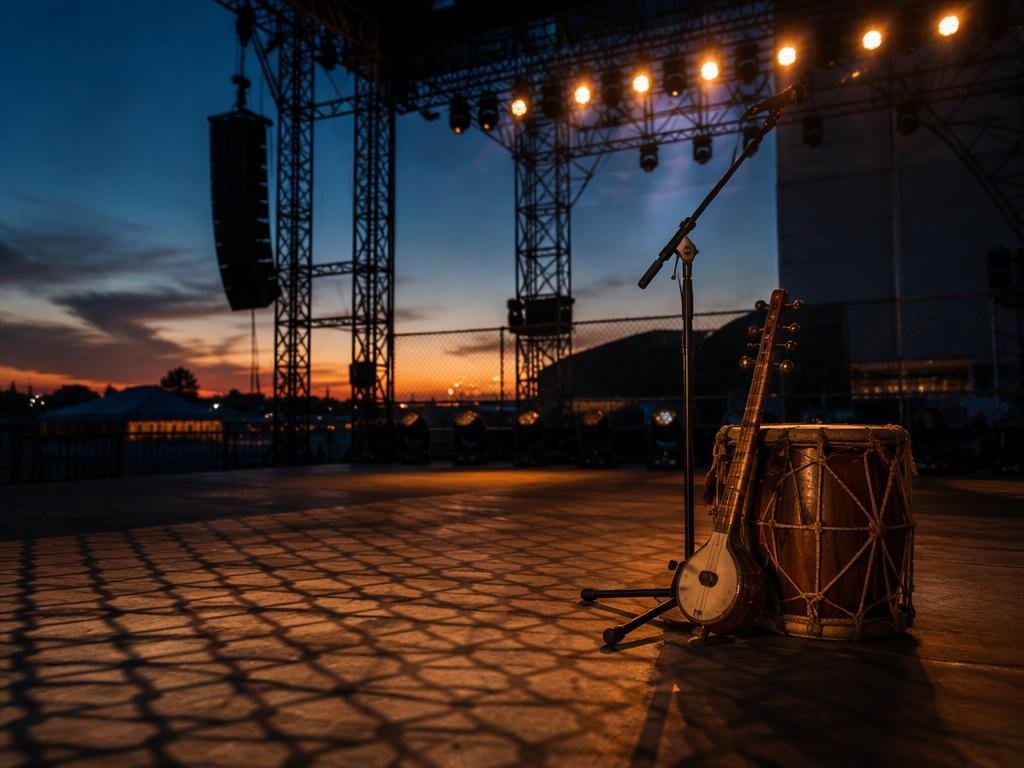
He’s far from alone. Parmish Verma was shot in the thigh in Mohali in 2018 by a gangster named Dilpreet Singh, who claimed the hit on Facebook; Verma survived, and Punjab police later said he’d quietly paid the shooter protection money through hawala channels to make the threats stop. When that payment became public, police briefly pulled his security detail, until then-DGP Suresh Arora overruled it, arguing the state’s duty to protect a threatened citizen didn’t evaporate because he’d also paid a bribe. Gippy Grewal fielded extortion calls that same year. Karan Aujla was threatened by the Harry Chatha group in 2022, his family named directly in the messages. A 22-year-old singer named Navjot Singh was found shot dead in Dera Bassi that same year. None of this required Moose Wala’s assassination to happen first. It just took his murder to make outsiders notice a pattern that Punjab’s music scene had been living with for years.
Pramod Kumar, who directs the Institute for Development and Communication in Chandigarh, put it plainly to reporters: extortion and protection money have become a given in the industry, and the underworld now expects its cut. That’s the part that rarely survives translation into Western entertainment coverage: this isn’t stalker behavior or isolated threats. It’s a functioning shakedown economy layered on top of one of India’s fastest-growing music scenes, one industry estimate puts at roughly ₹700 crore and still expanding by more than 10% a year.
That growth is inseparable from the diaspora, and so is the danger. Karan Aujla, one of the singers the Harry Chatha group threatened, is also the genre’s biggest current draw: his songs made up four of Apple Music India’s ten most-played tracks of 2025, and he headlined the first Rolling Loud India. A meaningful share of Punjabi music’s audience sits in Toronto, Vancouver, Birmingham, and Southall, not Ludhiana. That’s also where the gangs live now. In September 2024, two men hired by the Bishnoi network set fire to vehicles outside AP Dhillon’s home on Vancouver Island, then fired fourteen rounds into the windows and garage. One of them, Abjeet Kingra, had arrived in Canada four years earlier on a student visa; he’s since been sentenced to six years and faces deportation to India, where he now says the same gang that hired him is threatening to kill him. Dhillon’s offense, per investigators, was producing a video featuring Salman Khan, whom the Bishnoi camp has targeted for years over a decades-old blackbuck poaching case. Gippy Grewal’s Vancouver home was hit the same way in November 2023, with a Bishnoi-linked Facebook post warning in Punjabi that no one could protect him.
American and Canadian prosecutors describe a network that’s outgrown any one country: Lawrence Bishnoi has run it from an Indian prison cell using encrypted apps, while associates in the U.S., Canada, Britain, and Europe use WhatsApp and Signal to relay demands, cross-referencing government records and social media to pick targets before arranging shootings back in Punjab if payment doesn’t arrive. Two dozen arrests across the U.S., Canada, and Europe this month, part of an investigation called Operation Hard Ball, barely dented it.
Aulakh is still releasing music. So is Dhillon, still living in the house the bullets went through. That’s the part that doesn’t fit neatly into a headline — the industry isn’t pausing for any of this, it’s just absorbing it, one increased security detail at a time, as the price of getting big enough to matter to men who’ve never heard the songs.
Sources
- Punjabi singer Mankirat Aulakh targeted in extortion bid, accused arrested at Delhi airport — The Tribune, 2025
- Singer Mankirt Aulakh Receives Death Threat, Gangster Link Suspected — Bold News
- After Sidhu Moose Wala, Mankirt Aulakh on Goldy Brar’s radar? Singer gets threats, increases security — DNA India, 2022
- Sidhu Moosewala Not The First, Punjabi Singers Have Long Been In Line Of Gangsters’ Fire — Outlook India
- India: Why are Punjab Singers Under Attack by Criminal Gangs? — NewsClick, 2026
- Punjabi singer to lose security over “hawala” payment to Dilpreet / Security to Parmish will continue: Police — The Tribune
- Man sentenced in shooting at B.C. home of AP Dhillon says Bishnoi gang is threatening to kill him — CBC News
- Deportation order issued to shooter convicted in Bishnoi gang attack at home of AP Dhillon — CBC News
- International Crackdown on India-Based Organized Crime Gangs Results in 24 Arrests in U.S., Canada, and Europe — U.S. Department of Justice, July 2026
- 24 Arrested As US, Canada, Europe Crack Down On India-Based Organized Crime Networks — HNGN, July 2026
- What is the Punjabi music industry worth? — Krrish Music
- 25 insights about India’s music industry in 2025 — Music Ally, December 2025
- Karan Aujla — The Canadian Encyclopedia
SEO
- SEO title: Why Punjab’s Biggest Singers Live Under Gang Threats
- Meta description: Mankirt Aulakh, AP Dhillon, and Karan Aujla keep facing gang extortion and death threats that link Punjab to Bishnoi-linked networks in Canada and beyond.
- Focus keyword: Punjabi singers gang threats
- Secondary keywords: Mankirt Aulakh extortion, AP Dhillon Bishnoi shooting, Punjabi music industry gang violence
- Slug: punjabi-singers-gang-extortion-threats
- Category: Culture & Diaspora
- Tags: Mankirt Aulakh, AP Dhillon, Karan Aujla, Sidhu Moose Wala, Lawrence Bishnoi gang, Punjabi music industry, Canadian Punjabi diaspora