
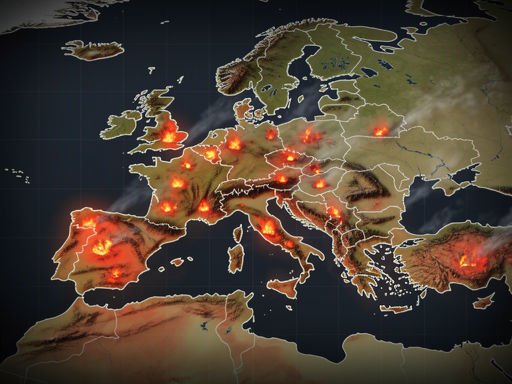
Every July now arrives with the same footage: orange skies over Mediterranean hills, tourists funnelled off beaches, firefighting planes dropping pink retardant onto blackened ridgelines. The summer of 2026 has delivered all of it. Fires have killed at least 15 people, forced tens of thousands to flee, and burned through Spain, Portugal, France, Greece, Italy and Turkey. It feels apocalyptic. But “all of Europe is burning” and “this has never happened before” are two claims worth testing against what the science and the satellites actually show — because the honest answer is more unsettling than the hyperbole, not less.
What the numbers say
Start with the tape. By 24 July 2026, the European Forest Fire Information System (EFFIS) recorded roughly 254,000 hectares burned across the EU — running about 40% above the 2006–2025 average, with more than double the usual number of fires for the date. France alone had already smashed its previous record, passing 42,000 hectares by mid-July, beating the mark set in 2022. Spain is fighting the La Mierla blaze in Guadalajara, near 32,000 hectares and one of the largest in its history.
So yes: 2026 is a bad year, the second-largest area burned in the EU in two decades — and the season is only half over.
But “unprecedented”? Not yet. That title belongs to 2025, which was, by a distance, the EU’s most destructive wildfire season on record: over 1.08 million hectares inside the EU, and 2.2 million across the wider Mediterranean region. In a single early-August heatwave last year, 22 very large fires in Spain and Portugal torched 460,000 hectares — nearly double what all of 2026 has burned so far. The uncomfortable truth is that 2026 looks severe precisely because the bar was reset so brutally the year before.
The science: three ingredients, all worsening
Fire needs three things — fuel, an ignition source, and weather that lets flames run. Climate change doesn’t light the match (most ignitions are still human), but it is systematically loading the other two dice.
The mechanism is fuel aridity. A 2026 study in npj Natural Hazards on Mediterranean megafires spells it out: months of soil-moisture deficit dry out vegetation until it becomes, in effect, kindling. Then a “fire-weather window” — anomalously hot, dry, windy days — arrives and the stressed landscape ignites easily and burns fast. Crucially, researchers find the jump from ordinary fire to megafire is tied to unusually warm nights (which no longer let fires calm down) and strong winds near the point of ignition.
June 2026 supplied exactly that priming. It was the hottest June on record for Western Europe, averaging 20.7°C — more than 3°C above the 1991–2020 norm — turning the Mediterranean into a tinderbox before the fire season had properly begun.
The attribution: this is not natural variability
Here’s where the science gets pointed. World Weather Attribution, the international collaboration that runs rapid analyses on extreme events, concluded the June 2026 heatwave was the most severe ever recorded over the studied region and that its intensity was “virtually impossible” to explain without human-caused climate change. Lead author Theodore Keeping of Imperial College London put it bluntly: “This event would not have been possible in June without climate change.” The heat that dried the fuel wasn’t bad luck — it was a fingerprint. And the human cost lands mostly through that heat: EuroMOMO data logged more than 10,000 excess deaths across 27 countries in the single peak week of 22–28 June, dwarfing the fire fatalities themselves.
So — unprecedented, or the new normal?
Both framings mislead. 2026 is not the worst year Europe has seen; 2025 was far more destructive, and fire has always been part of the Mediterranean’s ecological clock. What is genuinely new is the trend line underneath: seasons starting earlier (100,000 hectares had burned across the EU by the end of March 2025), fire creeping into cooler zones like the Pyrenees that models once considered fire-free, and back-to-back record or near-record years arriving without pause. As French fire chief Colonel Eric Belgioino said in early July, “Climate change is here… and it is only the start.”
The right word isn’t “unprecedented.” It’s escalating — and the peak of this summer hasn’t come yet.
Sources
- EFFIS / EU Joint Research Centre — 2025 was the EU’s most destructive season
- International Fire & Safety Journal — 2025 record: 1.08m hectares
- npj Natural Hazards — Megafires in Mediterranean Europe: fire weather and drought (2026)
- WMO — Western Europe’s hottest June on record
- World Weather Attribution — fossil-fuel emissions worsening European heatwaves
- CNN — Europe’s heatwave “virtually impossible” without warming
- Al Jazeera — climate change behind Europe’s “most severe” heatwave
- Anchorage Daily News / AP — Spain’s biggest-ever wildfires, 2026
- Euronews — France’s record wildfire destruction by mid-July 2026
- Inside Climate News — record heat drives Europe wildfires