
When Diljit Dosanjh climbed the Met Gala steps in May 2025, the cape falling from his shoulders carried an embroidered map of Punjab, its lettering set in Gurmukhi script. Prabal Gurung had built the whole ivory-and-gold look around early-twentieth-century Punjab royalty: a feathered, jewel-studded turban, a diamond necklace echoing a Cartier piece once made for a Sikh maharaja, a jewel-encrusted sword at the hip. On fashion’s most surveilled staircase, the first turbaned Punjabi to arrive there dressed not as a guest but as a maharaja who had decided to show up.
None of that is costume. Clothing has always done heavier lifting for people living between two places than it does for anyone settled in one. In a 2024 study in the journal Social Identities, researchers Rohit Dasgupta and Nazli Alimen spent ten months among South Asian shopkeepers and shoppers in Glasgow and found that what diaspora communities wear is never only self-expression. It is how they negotiate hybrid identities and mark, to themselves and to each other, who belongs and who doesn’t. Put that instinct in front of a musician whose every frame gets screenshotted, and the signal goes out at stadium scale.
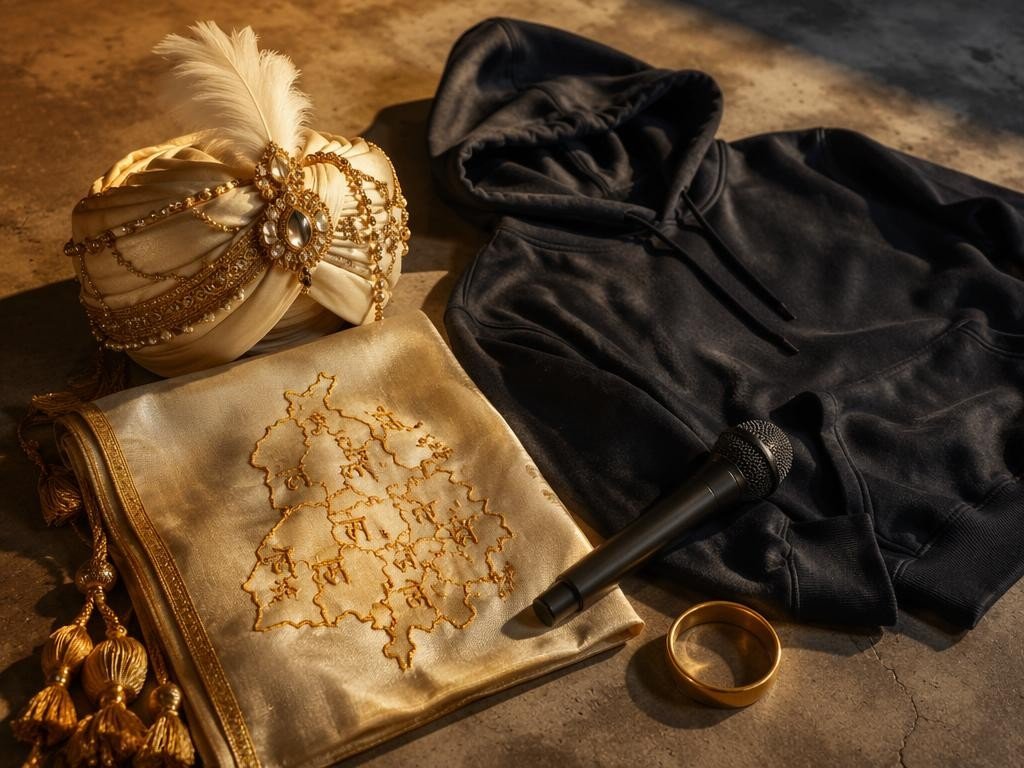
Not everyone reaches for map-on-the-cape maximalism. Karan Aujla, whose tracks pull hundreds of millions of streams, mostly moves in Amiri and Chrome Hearts, a palette of black, white and denim blue that could belong to any rapper from Toronto to Atlanta, until you clock the kara on his wrist or the specific way the whole silhouette reads Punjabi. AP Dhillon goes quieter still, Fear of God Essentials and monochrome, the heritage almost withheld rather than announced. Two artists, two opposite volumes, same underlying question.
That question is the one every diaspora kid gets asked twice: too brown for one room, not brown enough for the next. Babneet Lakhesar, the Toronto artist who hand-paints jackets as Babbuthepainter, has said flatly that she makes work in response to being told she is “too South Asian” in the West and “too Western” back home. A turban stacked with necklaces and an Essentials hoodie worn just so are two answers to the same standoff, and neither is wrong.
The clothes double as a rebuttal. Nisha K Sethi, who runs the California streetwear label Kalakari Crew, describes her work as “about reclaiming our identity in a society that is constantly appropriating culture.” That worry isn’t theoretical. For years bindis and mehndi surfaced on festival lawns, floated free of anyone who grew up with them. The brothers behind the label Rootsgear started it after 9/11, when a turban could get a Sikh man harassed or worse, and turned Punjabi hip-hop apparel into something closer to visible defiance than merch.
By Coachella this past April, that reclaiming had its own runway. Designers and creators like Sheel Yerneni styled entire crews in mini saris and custom Svarini pieces, one butterfly top clocking over two hundred hours of craftsmanship, while beauty creator Aditya Madiraju drew the line out loud: “Don’t call it retro, don’t call it vintage, don’t call it bohemian. Call it South Asian.” The same desert stage where Dosanjh became the first Punjabi artist to perform in 2023 was now ringed by fans who had dressed the part on purpose.
And the craft runs deeper than the red-carpet spectacle suggests. Around the turban alone there is a whole quiet economy now: bespoke, made-to-order versions, fusion textiles that pair heritage embroidery with modern weaves, and long-running debates among wearers over which cloth holds best, Full Voile for its structure, the lightest mal mal for an everyday dumalla. A garment that anti-Sikh violence once tried to make dangerous is being tailored, streamed and styled with obsessive care.
The maharaja reference in Dosanjh’s Met Gala look was pointed for a reason. Punjab’s royals were once photographed draped in jewels that European houses later locked into Western vaults; wearing that lineage back onto the world’s biggest fashion night is a quiet act of repossession. The garment says what the discography says. Punjabi artists are among the largest streaming forces on the planet right now, and they got there without sanding off the Gurmukhi, the folk melody, or the dumalla. The wardrobe is simply the thesis worn on the body: you don’t have to translate yourself to be heard.
Dosanjh’s world-tour merch, all pearls and sneakers and the map motif again, sold out in hours. Which tells you the fans weren’t only buying a T-shirt. They were buying the right to wear the same answer he does, to walk into their own too-brown, not-brown-enough rooms carrying a small embroidered map of exactly where they’re from.
Sources
- The UNN — Diljit Dosanjh’s Met Gala Look Symbolizes a Global Punjabi Style Revolution (June 2025)
- MusiCulture — 7 Artists Defining Streetwear in 2026 (Diljit Dosanjh, Karan Aujla, AP Dhillon)
- Forbes — At Coachella 2026, South Asian Fashion Is Proudly Taking Over (April 14, 2026)
- Homegrown — Indian Diaspora Artists & Labels Using Fashion To Reclaim Their South Asian Roots
- Dasgupta, R. K. & Alimen, N. — “Consuming and retailing fashion: South Asian diaspora negotiating clothing practices, identities and community making in Glasgow,” Social Identities 30(4), 2024
- Ranking / Alibaba — Punjabi Fabric 2026: Tradition, Innovation, and Global Sourcing Trends (turban textiles)
SEO
- SEO title: Diaspora Musicians’ Fashion: Wearing Where You’re From
- Meta description: From Diljit’s Met Gala turban to quiet-luxury streetwear, diaspora musicians’ fashion turns what artists wear into a language of belonging.
- Focus keyword: diaspora musicians fashion
- Secondary keywords: Punjabi streetwear, South Asian diaspora style, Diljit Dosanjh Met Gala
- Slug: diaspora-musicians-fashion-belonging
- Category: Culture & Diaspora
- Tags: Diljit Dosanjh, Karan Aujla, Punjabi streetwear, South Asian diaspora, Coachella, turban fashion