
At Raw Mango, a nearly thousand-year-old Chanderi weave gets printed with marigolds, lotuses, and stylized tigers and comes out looking like nothing your grandmother’s almirah ever held — and that’s precisely the point. Sanjay Garg’s label has spent years proving that a fabric this old doesn’t need to be treated like a museum piece to survive; it needs a designer willing to put a modern motif on it and let the weave do the rest. That instinct is now showing up across a whole generation of Indian labels, and this National Handloom Day, Harper’s Bazaar India rounded up enough of them to make clear this isn’t a scattered trend. It’s a movement with names, weaver networks, and a genuine commercial thesis behind it.
Start with what “handloom” actually means to these brands, because it’s not a synonym for rustic. At Eka, founded by Rina Singh in 2011, the philosophy is to celebrate the irregularities a hand-loom leaves in the cloth rather than iron them out — the slight unevenness in a weft thread becomes the texture, not the flaw. Singh works khadi, linen, and Jamdani into fluid dresses and tailored separates that read as minimalist rather than folkloric, which is exactly how she gets the fabric into wardrobes that would never buy a “heritage” garment on nostalgia alone.
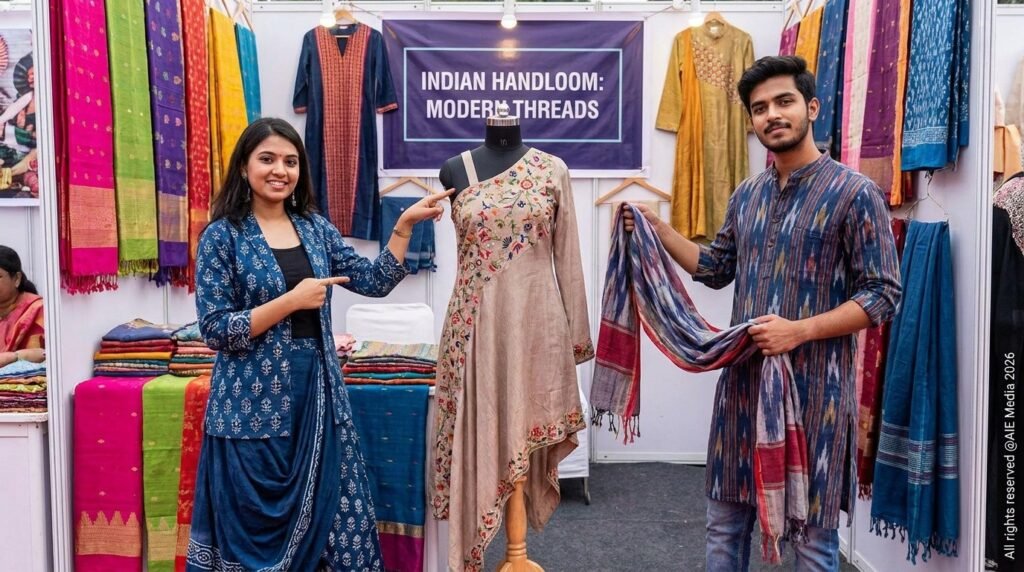
That same refusal to romanticize shows up at Jiwya, the label from designer Aishwarya Lahariya and her textile-chemist husband, who’ve built what they call a “soil-to-soil” supply chain: hand-spun, hand-woven, block-printed, naturally dyed, with zero plastic or animal-derived material anywhere in the process, and full traceability from raw fiber to finished shirt. Jiwya now works with more than 150 artisan communities, and one of its Mashru fabrics — a satin-weave silk-cotton blend most people outside the trade have never heard of — recently made it to the runway at Paris Fashion Week. That’s the part worth sitting with: this isn’t heritage craft being preserved in amber for a domestic festival market. It’s being exported as contemporary fashion, on its own design terms, to an audience that doesn’t know or care what khadi used to signify politically.
Because it did signify something specific, and still does. Khadi carries the Gandhian association with self-reliance and anti-colonial economics that no other Indian textile does, which is part of why its comeback reads differently than a generic “sustainable fashion” story. At 11.11/eleven eleven, sixteen years into building collections entirely from hand-spun Kala cotton, khadi, and wool dyed with indigo, madder, and pomegranate, the brand runs a “Meet the Makers” initiative alongside Kala Khoj, an artisan-owned producer collective in Kutch — putting ownership of the supply chain, not just labor, back with the weavers themselves. Ekaya Banaras is doing a parallel version of that math at a much larger scale: a 120-year-old Varanasi textile house working with more than 10,000 weavers, now collaborating with names like Masaba Gupta and Abraham & Thakore to turn Banarasi brocade into cowhide-print saris and sculptural jackets that would look at home on a runway anywhere in the world.
The regional spread matters too. Hannah Khiangte has spent a decade building a label around Mizo puan weaves and Eri silk — sometimes called peace silk because the moth is allowed to leave its cocoon before the fiber is harvested — sourced from women weavers across Mizoram, a textile tradition that rarely gets airtime next to Banarasi or Chanderi in the usual “Indian handloom” conversation. SWGT, launched in 2018, takes handwoven Chanderi cotton and silk and applies smocking, pleat tucks, and hand crochet inspired by Himalayan craft traditions, landing somewhere between heirloom textile and technical outdoor wear.
None of these brands are chasing the same customer, which is exactly why this reads as a real market shift rather than a single design house’s aesthetic. A diaspora shopper who wants a Banarasi sari with a story, one who wants an Eri silk jacket that’s never heard of a factory, and one who just wants a well-made linen shirt that happens to be handwoven — all three can find a label built specifically for them, using a fabric their families might have quietly stopped wearing a generation ago. The loom didn’t need saving. It needed someone willing to stop treating it as a costume.
Sources
- Meet the Indian fashion brands reimagining handloom for a new generation — Harper’s Bazaar India, August 7, 2026
- Anita Dongre to Ritu Kumar: 5 designers who are taking Indian handloom global — Global Indian
SEO
- SEO title: Young Indian Designers Are Reviving Khadi and Handloom
- Meta description: From Raw Mango’s Chanderi silk to Jiwya’s Paris runway Mashru, a new generation of Indian designers is reworking khadi and handloom for global wardrobes.
- Focus keyword: khadi handloom revival
- Secondary keywords: Indian handloom designers, contemporary khadi fashion, handwoven textiles India
- Slug: khadi-handloom-revival-young-indian-designers
- Category: Fashion
- Tags: khadi, handloom, Indian textiles, Raw Mango, sustainable fashion, South Asian diaspora